

Memorial Day Sale!

Best of DOA Camera
DOA Directors Get Married!
Drumlines Of America directors, J.D. Ralph & Ariell Fernandez kicked off the new chapter of their lives with a drumline proposal in front of about 19,000 live people and broadcast across the country. The Amway Center in Orlando, FL went wild with excitement as the engagement took place. Check out the video below…
The 2 are set to be married in a beautiful ceremony on June 9, 2018 in the Smoky Mountains. J.D’s hometown of Sandusky, Ohio had a local newspaper report on the huge engagement. Click here to read the full story.
Update: The wedding was a success!

For more information about the Orlando Magic, please visit OrlandoMagic.com
For more on the Orlando Magic RnB drumline, please visit their Facebook page.
Inside The Line: Atlanta Drum Academy
by J.D.
 Last month, the world stopped and watched as a pint-sized drummer, 5 year old Evan and all of his friends, stole everyone’s heart and proved that he had some serious drumming skills on Steve Harvey‘s ‘Little Big Shots.’ Evan has been studying drumming under Mr. James Riles III, owner and operator at Atlanta Drum Academy. Drumlines Of America had a chance to speak with Mr. Riles about his students’ appearance on the national tv program.
Riles, a former member of Morris Brown College‘s infamous drumline, says that he started Atlanta Drum Academy as a way to share his gifts for drumming and teaching with others. He credits this move to his experiences at the college and when he wrote cadences for the Drumline movies. So naturally when Little Big Shots called, Riles says that he was very excited. He also says that he did initially have a bit of hesitation as well because the group had previously auditioned, but was not chosen. Riles knew that his group had to “go big or go home!”
One of the difficulties that Mr. Riles faced in preparing his students for their performance was that the show only called for 13 performers. Atlanta Drum Academy has 40 students. “That process was the hardest,” he says. “The fact that there was an age requirement sort of helped.” Once the 13 students were chosen, Riles says that he had a blast preparing the kids for and filming the performance. Another part of the experience that stood out to Riles and his students was the Hollywood star treatment they received.
“They made us feel important,” Riles spoke of the trip. “The airport trip was really cool too, because they picked us up in these nice vehicles and the driver had a sign that read ‘Atlanta Drum Academy.’” He says the group also enjoyed the Hollywood Walk of Fame and being able to tour the city. Los Angeles is a long way from Atlanta, but most among us would agree that these students earned every bit of it.
Mr. Riles told DOA that he is hoping for more national appearances for his students. He also has his sights set on their very own practice facility for the future. He says no matter how things turn out for the group, they are going to continue working hard and doing what they love.
For more information on Atlanta Drum Academy, please visit ATLdrumacademy.com
Movement Pad Review
LSU Tunnel
Little Big Shots
Swiss Cheese Beats says Goodbye
Dynamics don’t matter!
by J.D.
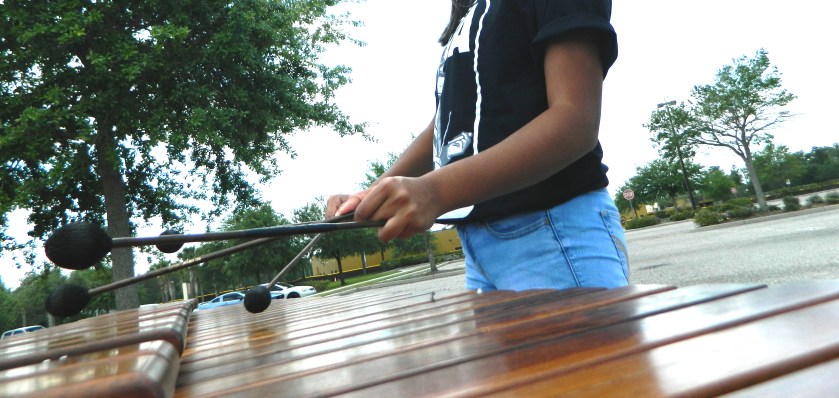
Often times, as percussionists, we focus on rhythms and articulations 1st (which you should), but many young percussionists tend to allow dynamics to fall by the wayside. A little louder here, a little softer there; doesn’t seem very important to an untrained ear, but it is! Here’s why dynamics and dynamic contrasts are so important…
Frame of reference:
As a child, you know that you live in the state of Florida (or whatever state you came from), but you first had to understand what America was, and Earth before that. Music is similar. For my audience/judges to understand that I am playing a soft ballad, I must at some point contrast this with a loud and brash ram. If I simply play loud and never show them soft, there would be nothing to compare it to. The frame of reference would be lost, diminishing the effect of the music.
Expression:
Most experienced and seasoned musicians see music as an entity that can take on a life of it’s own. As humans, music should present a color and expressiveness in life that connects us to one another. You understand me because I somehow understandably convey what my idea is. Music is the same way, you want it to connect with the audience. Dynamics are a very large portion and what some consider the basis for musical expression. Creating and releasing tensions is a key role that dynamic fields play when utilizing musical expressions. Here’s an example: The arranger says, “I’d like to build this section of the piece a bit more without changing the entire structure, so lets utilize a crescendo.” This is often botched by many percussion groups. Lots of indoor shows tend to start with some sort of soft introduction or harmonic bed laid down by the mallet players and the arranger intends to introduce the drums by building into it, many times starting off with a battery solo. Often we hear these solos played way too loudly, breaking away from the track the arranger had put us on. Now we cannot build our volume into the drum sounds, there is no perceived crescendo, and we have just disconnected the audience. This also disconnects judges, and when that happens, scores suffer. These are the reasons dynamic expression is so important.
Education:
As a professional percussionists, it is my job to demonstrate impeccable control over my instrument’s sound. Dynamics are a huge part of this. Students who strive to take their skills beyond the high school realm must understand and demonstrate the same; as most colleges, independent lines, drum corps, and professional ensembles will expect a reasonable amount of dynamic control out of them. Being prepared for these ensembles is of extreme importance and demonstrates the type of attitude that they will look for. Sending a student into a post-high school audition without the tools that will allow them to achieve dynamic superiority would be a grave error for any instructor teaching younger children in our activity. We have a dynamic standard, and students who intend to continue with percussion must strive to meet it.
So for those students/instructors that don’t focus much attention on dynamics, you are doing your students and yourself a great disservice. Dig in, sculpt the music, and make those phrases sing out! It is an essential part of what we do.
 Drumlines Of America